

New Data Shows Seniority-Based Layoffs Would Reverse a Decade of Progress
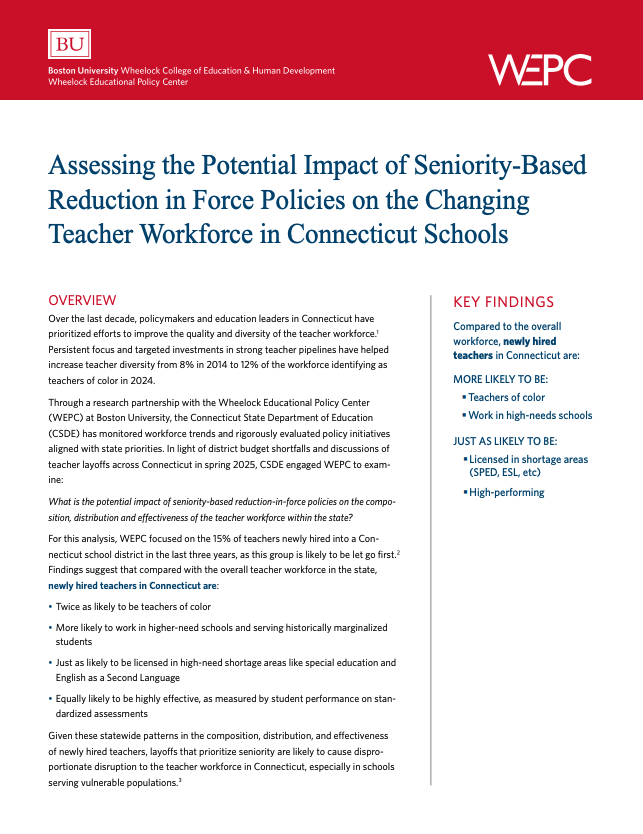
Connecticut has invested significant time, resources, and political capital over 10 years to expand the teacher pipeline, which has added approximately 1,700 new educators who better reflect and serve our students. They now lead the nation in diversifying the teacher workforce, growing from 8% to 12% teachers of color.
Seniority-based layoffs during this budget crisis could erase much of that progress in a single year. New data from the Wheelock Educational Policy Center at Boston University tells us why.

Connecticut added approximately 1,700 teachers of color over a decade of strategic investment. Last-in, first-out layoff policies could eliminate roughly 1,500 of them, erasing this progress.
What the Data Shows
Compared to veteran teachers, Connecticut's newly hired educators (i.e., those who have been in the profession for less than three years) are:
More Likely:
Teachers of Color
Special Education Licensure
Just as Likely to Be:
Serving High-Needs Schools
High-Performing Rating

The Takeaway
Seniority-based layoffs would disproportionately eliminate diverse, effective teachers who are serving our highest-need students.
Teacher Diversity at Risk
22% of newly hired teachers are teachers of color vs. 12% of veteran teachers.
Because teachers of color are concentrated among recent hires, seniority-based layoffs would disproportionately affect them.
Black Teachers
Hispanic/Latinx Teacher
The Takeaway
A single round of seniority-based layoffs could undo a decade of intentional workforce development toward a teacher workforce that better reflects our students.
High-Need Students Lose Most
Newly hired teachers disproportionately serve Connecticut's most vulnerable students.
Serving Economically Disadvantaged Students
Teachers Working in Alliance Districts
Working in Majority Black/Latinx Schools
The Takeaway
Seniority-based layoffs would pull teachers from the schools and students who need them most.
The "New Teacher Myth”
Question: How do newer teachers perform in the classroom?
Reality: New teachers perform just as well as their veteran peers.
Value-added model (VAM) analysis, which measures teacher impact on student achievement, shows that newly hired teachers are just as likely to be effective.
STEM Licensure
ELL licensure
SPED Licensure
The Takeaway
New teachers perform just as well as their veteran peers. We could lose excellent teachers simply because they are earlier in their career.
Newly hired teachers fill shortage areas at similar rates as veterans.
But seniority-based layoffs could displace more than 1,100 SPED-certified teachers and 250 ESL-certified teachers from the workforce, exacerbating existing shortages in these critical areas.
Critical Shortages Would Worsen
Licenses Held By Newly Hired Teachers
The Takeaway
We'd lose teachers in shortage areas we're desperate to fill.
About This Analysis
This research was conducted through a partnership between the Connecticut State Department of Education and the Wheelock Educational Policy Center at Boston University. The analysis examined 6,750 teachers hired in the last three years, who are most vulnerable to last-in-first-out policies. For more information, visit https://wheelockpolicycenter.org/.

Connecticut Can Do Better
These findings don't have to become reality. Connecticut law gives districts flexibility to modernize layoff policies. They just need to use it.